My Take on Procrastination
I have always read in every book and article that procrastination is caused by failing to regulate our emotions. That seems right, but most books stop at that point and do not give further information. Today I read about Goal Orientation Theory, and I think by connecting procrastination to this framework, we may gain a better understanding of ourselves and procrastination.
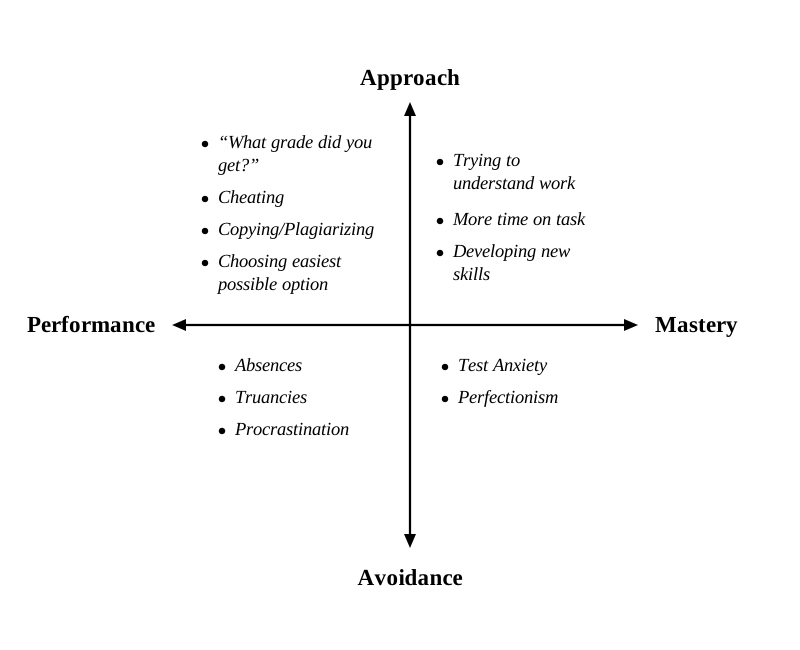
The image explains goal orientation theory and is taken from this YouTube video. Your definition of competence is on the X axis: you either measure competence intrinsically, by an absolute measure related to the task itself (Mastery), or extrinsically using comparison with others (Performance). The Y axis indicates your motivation, whether you pursue a goal in order to avoid a negative outcome (Avoidance), or because you wish to attain a desirable outcome (Approach).
Now, I wish to boil down the human mind to the simplest model possible: a human brain tries to avoid pain and attain pleasure. If we're steering away from what's clearly beneficial for us then there should be some pain involved. A pain that's lurking in a corner that we can't see, but it's preventing us from doing what's in our best interest anyway. Looking at this through the lens of goal orientation, the emotional pain caused by tasks that we face could take three shapes. The joy, one.
Mastery-Avoidance (fantasized perfection): I fear not being good enough
Authors of "The Courage to Be Disliked" explain this a lot better than I. We do not go after change and happiness because we're scared. The real reason we don't do something that is so clearly important for our life's mission is this — more often than not:
I have a young friend who dreams of becoming a novelist, but he never seems to be able to complete his work. According to him, his job keeps him too busy, and he can never find enough time to write novels, and that’s why he can’t complete work and enter it for writing awards. But is that the real reason? No! It’s actually that he wants to leave the possibility of “I can do it if I try” open, by not committing to anything. He doesn’t want to expose his work to criticism, and he certainly doesn’t want to face the reality that he might produce an inferior piece of writing and face rejection. He wants to live inside that realm of possibilities, where he can say that he could do it if he only had the time, or that he could write if he just had the proper environment, and that he really does have the talent for it.
All of us possess a self-image, someone who we think we are. I personally feel like a great writer, someone else might think they're really good at math. This self-image has nothing to do with reality, I have not much to back up my claim. Being destined to become a great writer is just a story I tell myself. However, we usually cling to an unrealistic self-image desperately and way more than we should. I cannot come up with the name of a single society where people are celebrated for being ordinary, making mistakes, or being bad at something but giving it a shot anyway. So it hurts a lot when we realize that we're not exceptionally talented or special. We like to think of ourselves as special, at least at some things, and an existential crisis might happen at the moment we realize that we're mediocre and just like everyone else.
Once we commit to an action, we shatter all the fantasies of our self-image and are faced with something concrete, and most of the time, the fact is that we suck; while what we fantasized was supposed to be easy for us to do but not for others, was supposed to bring us fame, cheerings of others, and high acclaim. So we tarry.
But as Ira Glass puts it, there is no way we can achieve that ideal stage in our work, unless we endure the "slog", keep creating, keep putting ourselves out there, and keep growing:
Nobody tells this to people who are beginners, I wish someone told me. All of us who do creative work, we get into it because we have good taste. But there is this gap. For the first couple years you make stuff, it’s just not that good. It’s trying to be good, it has potential, but it’s not. But your taste, the thing that got you into the game, is still killer. And your taste is why your work disappoints you. A lot of people never get past this phase, they quit. Most people I know who do interesting, creative work went through years of this. We know our work doesn’t have this special thing that we want it to have. We all go through this. And if you are just starting out or you are still in this phase, you gotta know its normal and the most important thing you can do is do a lot of work. Put yourself on a deadline so that every week you will finish one story. It is only by going through a volume of work that you will close that gap, and your work will be as good as your ambitions. And I took longer to figure out how to do this than anyone I’ve ever met. It’s gonna take awhile. It’s normal to take awhile. You’ve just gotta fight your way through.
If you spot any of these thoughts during your inner dialogues, you're facing Mastery-Avoidance:
- What if I fail to uphold the previous (successful) image I created for myself (in my mind and/or in other people's minds)?
- What if I am not good enough?
- What if I make mistakes?
- What if I can't make it?
- What if what I do is not perfect?
- What if I'm not smart/privileged/… enough to complete this task?
Performance-Avoidance (avoiding humiliation): I fear how I compare to others. I care too much about what other people think.
This is a big one. Each time we see someone in our field with the same age and background, who has achieved something significant, it is very easy to ask "Why not me?". While a moderate amount of this is healthy as long as it is spent on retrospection and learning, and not berating oneself, it could take a dark turn and make us lose self-esteem and self-confidence.
I love the motto "Life is not a competition". We have to remind ourselves that while we should try our best, no two people are the same, and we are worthy in and of ourselves regardless of our achievements. Comparing achievements is a losing game anyway, there is always someone richer, prettier, …er than us. The world is a big place! Always remember: you're unique and bring to the world and your community invaluable benefits that even you may not recognize. No need to spoil what great things you offer to the world and fail to notice, with another person's highlights of life.
Each attempt at growth is going out on a limb, and we perform all this in front of a society. It takes courage to go out on a limb. It takes high self-esteem to make yourself vulnerable, to make mistakes in front of an audience, and to learn from them.
If you spot any of these thoughts during your inner dialogues, you're facing Performance-Avoidance:
- What if I try and make a fool out of myself in front of others?
- What if other people berate me for how little I have achieved?
When these questions are asked, we conclude that it's better to stall and stay invisible so that we don't give others a reason to judge or expose us, proving that our self-image has been a fraud all along. Due to attaching our worth to the judgment of others, we naturally self-handicap. This is something we'll arrive at shortly, but in its simplest form, if we wait until the last minute, poor quality looks like a lack of time rather than a lack of ability. We and others could be given a reason to be gentler in our harsh judgments.
Performance-Approach (winner's ego):
This is a double-edged sword as it can help some people procrastinate less, and it is a necessary part of life in moderation. But it could also cause anxiety by asking these questions:
- What if I try my best but still am not the best?
- What if I'm not smart/privileged/… enough to be better than others in this task?
Asking these questions, we have to worry about whether we're valuable at all, when compared with others.
Self-worth and Self-handicap
In all of the scenarios discussed above, the pain is created by doing something and the ensuing judgment. With these mindsets whatever we do, we never truly win. There is always some better 'true potential', better 'person' to compare ourselves to. If our self-worth is constantly questioned and pain is created by doing something, we could just as easily resort to not doing anything; or when we absolutely have to, we could take a second approach: self-handicapping.
Self-handicapping occurs when a person creates an intentional obstacle for themselves in the path of achieving their goals. Why would we do this? Because it makes the hounds of judgments unleashed on us by ourselves or other people gentler. We can forgive ourselves more easily if the goal is "hard" to achieve; it doesn't matter if this hardship comes from our doing or the external world.
The more we attach our self-worth to the extraneous, the lower our self-esteem. With low self-esteem, we're more susceptible to feeling bad after failing to achieve. We fear failure and being unworthy. We sense shame about who we are, and ultimately we self-handicap more — trying hard to maintain a good self-image by pitying ourselves with if-onlys.
Following this rationale, it is very natural and smart to self-handicap. We procrastinate and put what matters off till the last minute where a perfect achievement is impossible, or keep telling other people that we expect to fail for this and that reason. In both scenarios, by setting ourselves up for failure, we protect our self-image, and even better, if we produce something good, we bolster our self-image because this achievement happened despite the self-handicap. The root cause of self-handicapping is nothing but caring about some image. We want to make the world have a better image of us. And what better way to create it than by self-handicapping? But it's a downward spiral.
When our self-esteem is attached to some external outcomes, we won't give anything our 100% so that our illusion of potential remains intact. If we never begin a task, or begin but do not commit to it, then we never truly failed our own standards, and preserve our self-image as a result. This makes us not learn from our failures because we believe we never failed, just didn't commit to it enough. And sadly preserving one's self-image comes at the cost of an unlived life.
Mastery-Approach (letting go of the ego): I believe my self-worth is independent of the outcome. Every failure to achieve is a chance to learn and grow.
Following the logic of a simple reward-pain brain, we introduced different forms of pain so far. But how about joy? The joy could be framed as Mastery-Approach.
Mastery-Approach goes hand in hand with a growth mindset: I am a valuable, capable human being regardless of my material gains or achievements. When I take risks, and when I start doing something, I will grow as a person. I enjoy the process of learning. Making mistakes is natural and a sign that I'm stretching the boundaries of myself and growing. I don't need to do this better than anyone; I just need to try to grow and be better than my previous self.
So the antidote is Mastery-Approach: to play for the love of the game itself, for improving ourselves compared with our previous selves, to live according to our values not to achieve some arbitrary standards, to take risks and do things (even badly) because it helps us grow, to have a long-term vision, to value growth over material gain or other people's opinion of us. To quote Sting:
He deals the cards as a meditation
And those he plays never suspect
He doesn't play for the money he wins
He doesn't play for respect
He deals the cards to find the answer
The sacred geometry of chance
The hidden laws of a probable outcome
The numbers lead a dance
Definition of Success and Attitude Toward Failing to Achieve
I have this idea that perhaps procrastination, and more broadly the quality of our life, how much we get to actually live instead of going wherever the wind takes us, is closely related to our attitude toward making mistakes. Everyone makes mistakes. But if you set perfectionist standards and judge yourself too harshly when you think about past actions, it naturally makes you tend to hesitate and withdraw. It makes you hide more and live in your head. After all, sins of omission are easier to rationalize, less obvious as errors, and no one can directly point to an action you have never committed.
How do you perceive failure to achieve? To some people, failure of achievement is a form of success. Here's the Spanx founder explaining the correct attitude toward making mistakes:
Growing up, my father used to ask my brother and me what we had failed at at the dinner table, which was so interesting. And he'd celebrate it, and he'd actually be disappointed if I didn't have something that I failed at that week.
So I can remember saying, "Dad, Dad, I tried out for this, and I was horrible." And he would actually high-five me and say, "Congratulations, way to go!" And what it did was just reframe my definition of failure.
Failure for me became not trying versus the outcome. So so many people don't take risks for fear of failure. They don't start the business, they don't go create the art they want to create, or they don't go try out to be in the play, or whatever it is, for the fear of failure. And once you redefine that for yourself and realize that failure is just not trying, then life opens up to you in many ways.
And I would also—my dad would encourage me anytime something didn't go the way I expected it to, or maybe I got embarrassed by a situation, to write down where the hidden gifts were and what I got out of it. And I started realizing, in everything, there was some amazing nugget that I wouldn't have wanted to pass up.
Like I said, most people equate success with trying and achieving what they wanted. But success is to make the best choice available to you at the moment, taking risks, having tried, and learned from the outcome, whatever it may be.
Failure to achieve does not need to also be failure to grow and learn. Each failure to achieve is a success and a step in the right direction so long as we learn. The real failure is failure to commit. In this view, we reframe pain and put the guilt in failing to act, not in acting and failing to achieve. This sounds simple to say but could be life-altering.
Msic Notes
[2026-09-11]: Updated to add self-handicapping and integrate attitude toward mistakes.
Practical Advice
- Be aware of your emotions and thoughts. Each time you procrastinate identify which of the three you're facing.
- Make tasks so easy and so well defined they're not intimidating.
- Lower your standards and allow yourself to deliver imperfect rather than perfect. (volume of photography over quality story)
- Lower your standards and allow yourself (in fact force yourself) to publish things despite knowing that they could be better if you just changed a few more things… (simonw)
TODO
- Write a blog post about how changing happens by telling ourselves a new story about ourselves: 'We can choose and be whoever we want living moment by moment. Some would say that pretending. Kurt Vonnegut said : “We are what we pretend to be, so we must be very careful about what we pretend to be” to change tell yourself a different story.' and the connection between self-image and "living in bad faith" of Sartre.
Sources
The contents of this post was somewhat complemented by content from this blog post and this one.
Have thoughts or questions? I'd love to hear them:
Delta Chat
hossein@naghdbishi.com (pgp)
Want more content now? This blog's archive has 52 ready-to-read articles. I also curate a list of cool URLs I find on the internet.
Found a mistake? This blog is open source, you can always open an issue.
Thanks for reading! ♡ All content on this blog is licensed under